By
November 10, 2026 at 6:00 a.m.
Last Updated: November 11, 2026 at 11:50 a.m.
It all began with two photos Amynte Eygun had unearthed in the attic of a veteran Canadian soldier. And from those wee beginnings, the franco Nova Scotia museologist and curator, now living in Montreal, started digging a lot deeper and was able to put together the compelling new exhibit The Sacrifice at Ypres: The Stories of French-Canadian Soldiers of the RMR in World War One, which is on display at the west-end Major-General Charles Basil Price Armoury until Nov. 15.
A dozen panels of illuminating photos, stories, letters and vintage archival information — touching on everything from trench warfare to postwar reintegration back home — deftly convey these stories for RMR (Royal Montreal Regiment) Remembrance Day proceedings this year.
There were five Battles of Ypres, but this exhibit focuses on the second. It was fought from April 22 to May 25, 1915 in Flanders, Belgium, and served as a defining moment in Canadian military history, marking the first major engagement of Canadian troops, including two French-Canadian companies, during the First World War.
It was a hideously gruesome battle, with German forces unleashing lethal chlorine and mustard gas for the first time on the Western Front. In the first two days of battle, more than 2,000 Canadian soldiers died, which was to inspire Canadian Lt.-Col. John McCrae to pen one of the most memorable war poems of them all, In Flanders Fields.
But what has often been overlooked were the efforts of these two francophone companies of the RMR, whose steadfast contributions played a vital role in the Allies’ strategic victory in the Second Battle of Ypres.
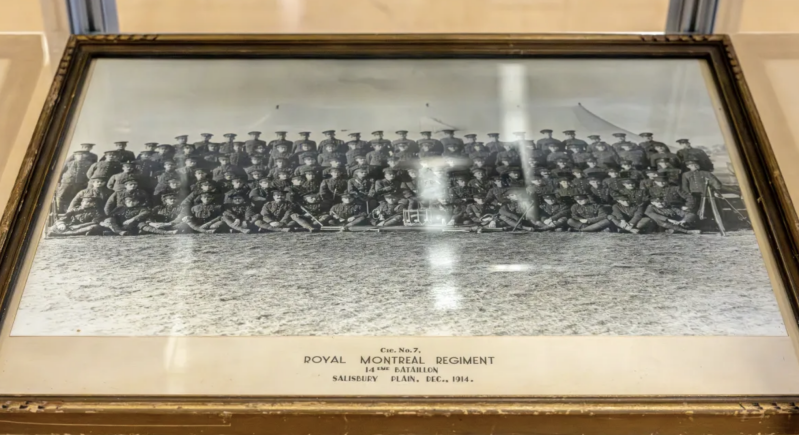
A photo of the No. 7 company of French-Canadians during the First World War is seen in the exhibit The Sacrifice at Ypres: The Stories of French-Canadian Soldiers of the RMR in World War One. Dave Sidaway / Montreal Gazette
“The two pictures I found were group photos of the No. 7 company, which we now know to be one of the French-Canadian companies of the RMR, numbering 200 soldiers and led by francophone officers,” Eygun notes. “This enabled me to get in touch with family members of these troops, which led to me receiving letters and more information about the company and its involvement in the battle.
“Much of the thinking back then was that French-Canadians weren’t interested in getting involved in the war effort, but our research shows something else.”
The prevailing view was that a majority of French-Canadians opposed conscription in the First World War, largely because they felt no particular loyalty to Britain or France. This was to lead to the Conscription Crisis of 1917.
“This all dawned on me as I started going through the war archives and finding service records, learning what they did and what happened to them. And this all led to creating a story that too few are familiar with, about not only having to fight but the terrifying effects of dealing with poison gas.”
In lieu of gas masks, soldiers had to rely on breathing through soaked handkerchiefs — often drenched with urine — to neutralize the chlorine. It is estimated that about 65 French-Canadian soldiers died in the battle.
“Quite a few were never found,” Eygun says. “It has to be remembered that many of these soldiers were on the front lines and showed great heroism. Ypres was considered a success for the Allies even though so many lives were lost.”
“It has to be remembered that many of these soldiers were on the front lines and showed great heroism,” Amynte Eygun says. Dave Sidaway / Montreal Gazette
Eygun also points to another reason why some felt that francophones here weren’t more involved in the war effort.
“It’s because they weren’t signing up for the English battalions because they couldn’t speak English,” she says. “They needed a battalion that spoke French with French officers. There are a few, like the 22nd Regiment in Quebec City, which is fully French. And the RMR is fully bilingual.”
Former RMR commanding officer Colin Robinson — who has long been involved in RMR Remembrance Day exhibits — is quick to add: “The idea of bilingualism in the Canadian Armed Forces seems self-evident today, but in the First World War it was very progressive. In fact, the RMR was the first bilingual unit in Canadian military history.”
Georges Gohier, a former regimental sergeant major of the RMR, has more than a passing interest in this exhibit. His maternal grandfather, Henri Desrosiers, served with one of the francophone RMR companies in the Second Battle of Ypres.
“My grandfather passed away in 1963, when I was all of nine, and like so many vets who had lived through terrible times in battle, they didn’t like talking about the war at all. I was to learn later what he went through. Some vets did talk with fellow soldiers at taverns and legion halls around town — those were like therapy rooms for them,” says Gohier, who provided photos and other items for the exhibit.
Desrosiers rose from the ranks of lieutenant to captain in Europe and arrived back in Canada as a lieutenant-colonel. Under Prime Minister William Lyon Mackenzie King, he would serve as deputy defence minister during the Second World War.
“French-Canadians often get such a bad rap for our military service, so this show brings a large measure of pride,” Georges Gohier says. Dave Sidaway / Montreal Gazette
“French-Canadians often get such a bad rap for our military service, so this show brings a large measure of pride,” says Gohier, pausing at a Canadian Army recruiting poster in French from that era in the exhibit.
“What our soldiers went through there was pure hell. Fighting is tough enough without having to deal with mustard gas. … A lot of French-Canadians essentially vanished into thin air there.”
Gohier notes that among the more memorable European war monuments is a Canadian one near Ypres called The Brooding Soldier.
“It’s very striking, depicting a soldier resting on his arms and brooding about all the losses he has witnessed,” Gohier says. “It says it all.”
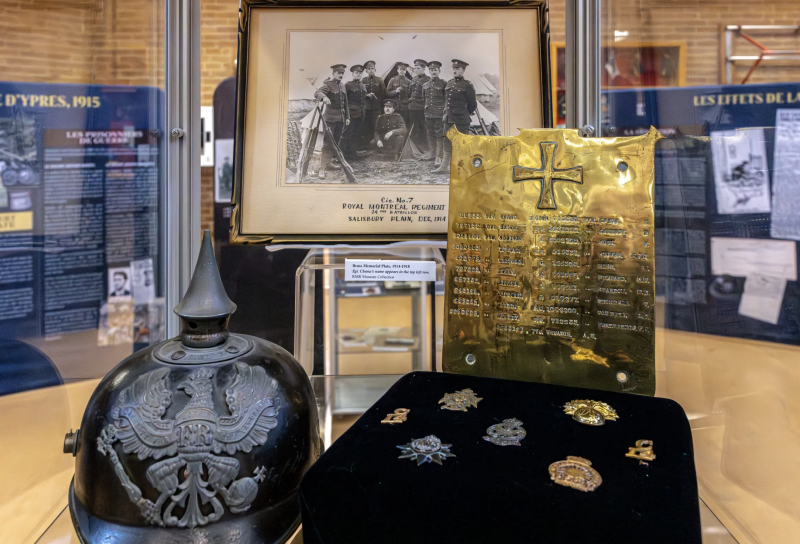
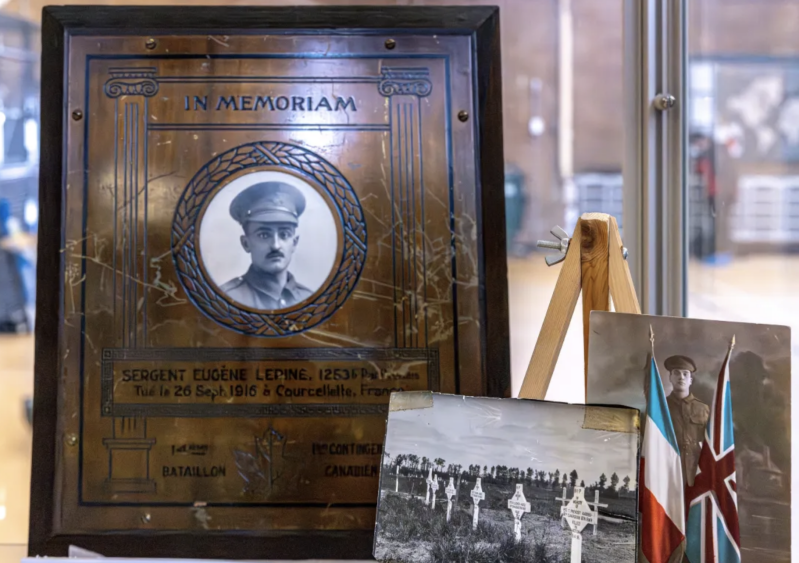
Images in the exhibit The Sacrifice at Ypres: The Stories of French-Canadian Soldiers of the RMR in World War One. Dave Sidaway / Montreal Gazette
Inspiring on another level is Eygun’s story. At a time when so many have forgotten about the price paid by Canadian soldiers over the years in sacrificing their lives in battle, and when so few young people are even remotely aware of our military history, 27-year-old Eygun’s concern stands out.
“I just love history,” Eygun says. “These soldiers whose lives I’ve learned about were mostly my age. The letters of the franco soldiers brimmed with pride, noting that they were fighting for French Canada. Yet they had to endure the sort of hardships that most of us can barely comprehend.
“It’s so important that we remain aware and always remember their service.”
She is doing her part.
AT A GLANCE
The Sacrifice at Ypres: The Stories of French-Canadian Soldiers of the RMR in World War One continues through Nov. 15 from 10 a.m. to 6 p.m. at the Major-General Charles Basil Price Armoury, 4625 Ste-Catherine St. W. Admission is free. For school and group visits, contact rmrmuseum.collection@gmail.com
bbrownstein@postmedia.com